What is it:
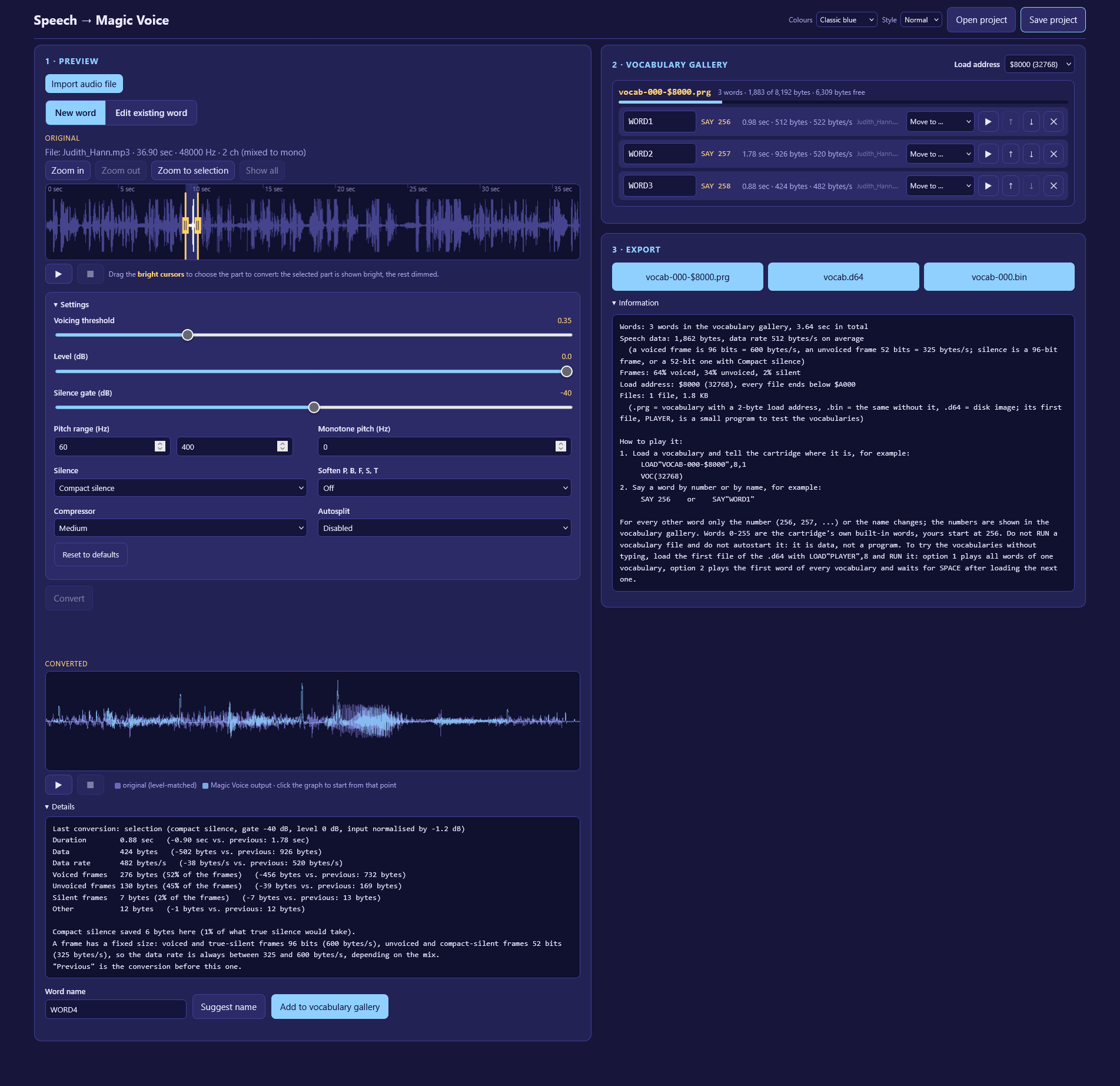
Finally a tool for anyone to create one or more vocabulary files for the Commodore Magic Voice cartridge, that's the thing I'm hoping for when people are reading this page. But let's start at the beginning. Commodore did lot's of promises regarding this cartridge but never delivered. It has been a great mystery for the Commodore community how these vocabulary files could be created. This prevented people from really using this cartridge as they way it was intended. This cartridge is in essence is an LPC (Linear Predictive Coding) decoder with a fixed ROM holding the LPC encoded words that can be "spoken" by addressing them using the coupled word or index. But it was also designed to "speak" using data directly from RAM, a function that was used by a few cartridges but that was never fully utilized on the promised disk based software.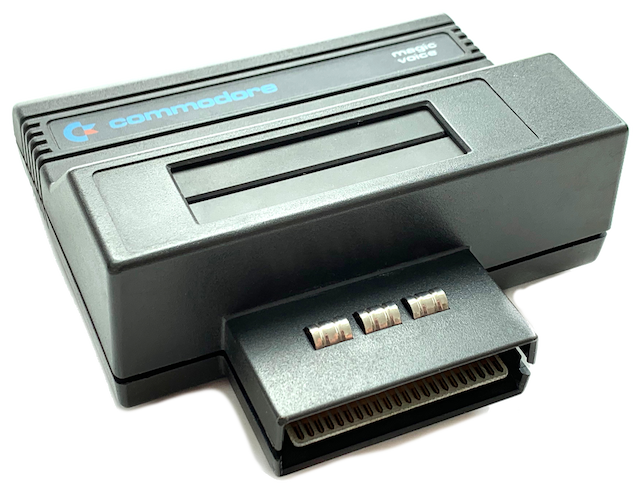 Thanks to the power of Claude (an AI tool that can do all sorts of stuff), it was actually relatively easy to reverse engineer this all and to create a tool that can generate a file the cartridge can actually play back. A file you can load into your C64 RAM and then play it through the cartridge. Just like it was intended by the creators more than 40 years ago but somehow never really materialized. It is one of the reasons why this cartrdige is also nicknamed "the Commodore Tragic Voice". Anyway... there never was a tool for the people at home to create their own vocabulary files, simply because the C64 itself or all the other home computer around at the time weren't really suited for that task. But today we all do have very powerful machines that are more than capable to do so, if we only had the software for it. And now we do and we can even run this software in a browser. So no matter if you have an ordinary Microsoft PC an Apple or a Linux machine... if it has a modern (2026) browser, it can run the tool. And it does so completely offline, so it is an independent system nobody can ever take away from you once you've downloaded it. Now how cool is that!
There only one tiny problem... not many people have a Commodore Magic Voice cartridge. And for those who want to try it out in VICE, they can... but the emulation (VICE v3.10) does sound awful, i hope they fix this some day. So in essence, this tool is really only useful for a very few people, but perhaps it might inspire them to do great things with it, have fun.
How it all started:
A while ago I was experimenting with speech compression on the C64 and came to the conclusion that what I wanted would simply require too much CPU time. Although the concept worked it all was way to slow to be practical and when compromises were made to make it work it was a far cry from the quality I hoped for. Those experiments involved LPC. This is a very impressive technology that compresses speech by simulating the way speech is produced. Instead of storing each and individual audio sample this system determines how the human voice is created (based on the vocal tract model). So it only needs to store/transfer the parameters that are needed to adjust the vocal tract model. Because this system simulates the human voice, it can only reproduce the human voice, it cannot produce music or awkward sounds a human cannot produce. This system goes back a long way and was first created using analog electronics to compress and encrypt telephone communications during WW2 war time. The speech compression system used by Winston Churchill during World War II was named SIGSALY (also known as Project X or the "Green Hornet"), which relied on an early channel vocoder and is the direct technological ancestor of LPC. While LPC itself wasn't developed until the late 1960s, SIGSALY pioneered the exact same core concepts: breaking down human speech into vocal tract parameters rather than transmitting raw audio waves.There are various versions of this system, LPC-10 is a very common one, which simply means it has 10 filter stages for reconstructing the sound. More filter stages is better, but at some point, the difference isn't worth the extra effort. And below 10 stages, quality begins to drop off pretty fast and combined wit a low samplerate it becomes unintelligible. Now, for a C64 to do this LPC decoding in real time at a let's say 5kHz samplerate, the C64 would need to do at least 10 multiplications at a rate of 5000 times per second. Now the C64 can do a lot, but fast multiplications aren't what this machine was made for. The same function can be done in dedicated hardware relatively easy and therefore a cartridge performing this task is the way to go, the cartridge produces analog sound, which is coupled into the C64 via a pass through audio connector or splitter cable. It leaves the SID chip completely free!. Here you can see a screenshot, feel free to download the entire tool (which is nothing more than a .HTML file you can run in your browser) in the download section below.